Chalk harness
Chalk runs Claude Code agents in disposable sandboxes, one small checkpoint at a time. Each loop has a spend cap, the harness runs your tests itself before anything is committed, and an agent that gets stuck stops and waits for a person instead of spending more. Finished work arrives as a GitHub pull request or a GitLab merge request.
Status: early
The whole workflow is covered by end-to-end tests with fake docker,
claude, gh and glab, and the SQL is tested against a real
Postgres. Chalk has had few runs against real projects yet, so expect
rough edges and please
report them.
Where to start
- New to Chalk: Getting started installs it, sets up a repository and runs a first ticket.
- Running tickets: The workflow, then Detention and office hours for when a run gets stuck.
- Tuning: Configuration lists every setting; the report card shows what to change.
- The words: Chalk names its parts after school. The glossary says what each one means; on every page, a term with a dotted underline shows its definition when you hover over it.
- Contributing: Architecture says where each part of a run lives, and Testing how to check a change without Docker or spend.
How a run works
flowchart LR
  spec[Spec check] --> loop[Agent loop on the next checkpoint]
  loop --> rubric{Rubric}
  rubric -- pass --> commit[Commit]
  commit -- checkpoints left --> loop
  commit -- all done --> review{Final review}
  review -- pass --> request([Pull or merge request])
  review -- findings, fix round --> loop
  rubric -- fail, retry --> loop
  loop -- blocker --> detention([Detention])
  rubric -- retries used up --> detention
review -- still failing --> detention- Chalk starts a container with your branch cloned into a RAM disk. The container has no GitHub or GitLab credentials.
- A cheap model checks that every checkpoint in the spec is small, testable and unambiguous. If not, the run stops before any loop is paid for.
- Each loop, the agent works on the next unchecked checkpoint under a spend cap. Then the harness runs the rubric, your test command, itself.
- When the rubric passes and a checkpoint was ticked, the harness commits the work to your local branch. Otherwise the agent gets the failure and tries again, up to a retry limit.
- When every checkpoint is done, an independent agent reviews the change. Its findings get one fix round.
- A passing review opens the pull or merge request.
- A reported blocker, exhausted retries, the loop limit or a review that still fails sends the run to detention: nothing is pushed, the work is parked on a local branch, and a person takes over in office hours.
A run that needs help
This recording runs the real chalk against the test fakes, so it is free
and the same every time. The agent keeps leaving a stray file that the
rubric rejects; after three loops the run goes to detention, a person
removes the file and explains it in office hours, and the resumed run
finishes and opens a merge request.
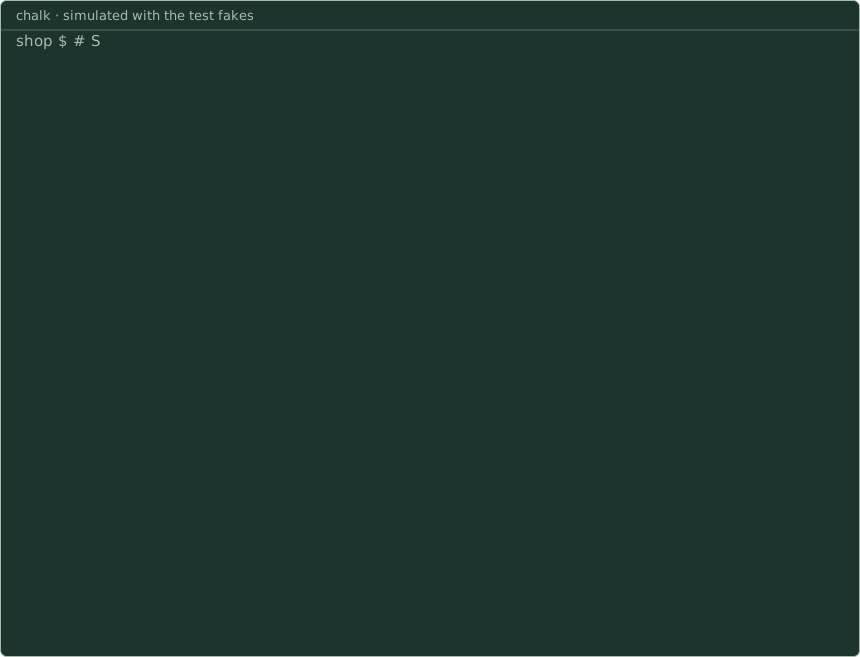
Select the image to play the recording.
Transcript
shop $ # Simulated with Chalk's test fakes: no Docker, no model calls, no spend.
shop $ chalk new SHOP-7 "Add a discount code field"
created /home/sam/shop.worktrees/SHOP-7 on branch chalk/SHOP-7
next: edit specs/SHOP-7.md, commit it, then run 'chalk run' from that directory
shop $ cd ../shop.worktrees/SHOP-7
SHOP-7 $ # Spec written and committed: two checkpoints. Each loop leaves a stray file.
SHOP-7 $ chalk run
[SHOP-7] starting the database and the sandbox image
[SHOP-7] starting sandbox chalk-sandbox-shop-SHOP-7 on chalk/SHOP-7
[SHOP-7] cloning chalk/SHOP-7 into the sandbox
[SHOP-7] checking the spec with haiku
[SHOP-7] spec check passed ($0.25, 0s)
[SHOP-7] loop 1 (continue) started
[SHOP-7] loop 1 (continue): agent ok ($0.25, 0s), rubric exit 1. did the thing
[SHOP-7] loop 2 (retry) started
[SHOP-7] loop 2 (retry): agent ok ($0.25, 0s), rubric exit 1. did the thing
[SHOP-7] loop 3 (retry) started
[SHOP-7] loop 3 (retry): agent ok ($0.25, 0s), rubric exit 1. did the thing
[SHOP-7] DETENTION: rubric failed (exit 1)
[SHOP-7] next: the rubric still fails after 2 retries; fix the failure in /home/sam/.local/state/chalk/shop/runs/SHOP-7/io/rubric.log, or make the checkpoint smaller
[SHOP-7] work parked on local branch detention/SHOP-7-1791215648. To unblock:
[SHOP-7]   cd '/home/sam/shop.worktrees/SHOP-7' && git switch 'detention/SHOP-7-1791215648'
[SHOP-7]   fix the blocker, commit, then: chalk office-hours -m "what was wrong"
SHOP-7 $ # Nothing was pushed. A person looks at the parked work and fixes it.
SHOP-7 $ git switch -q detention/SHOP-7-1791215648
SHOP-7 $ git rm -q BROKEN && git commit -q -m "Remove the stray BROKEN file"
SHOP-7 $ chalk office-hours -m "Never commit scratch files such as BROKEN"
lesson: Distilled: never commit a BROKEN marker
lesson recorded; continuing on tutoring/SHOP-7-1791215650
[SHOP-7] starting the database and the sandbox image
[SHOP-7] starting sandbox chalk-sandbox-shop-SHOP-7 on tutoring/SHOP-7-1791215650
[SHOP-7] cloning tutoring/SHOP-7-1791215650 into the sandbox
[SHOP-7] spec check skipped: it passed before and the checkpoints have not changed
[SHOP-7] loop 1 (continue) started
[SHOP-7] loop 1 (continue): agent ok ($0.25, 0s), rubric exit 0. implemented a checkpoint
[SHOP-7] loop 2 (continue) started
[SHOP-7] loop 2 (continue): agent ok ($0.25, 0s), rubric exit 0. implemented a checkpoint
[SHOP-7] final review started
[SHOP-7] final review: pass. Looks complete.
[SHOP-7] all checkpoints complete (5 loops, $2.00, 1 human interventions)
https://gitlab.example.com/acme/shop/-/merge_requests/42
The report card
chalk dashboard builds one HTML page from the telemetry on your machine:
the cost per finished checkpoint, the share of spend that made no progress,
and notes on what to tune. Nothing is sent anywhere.
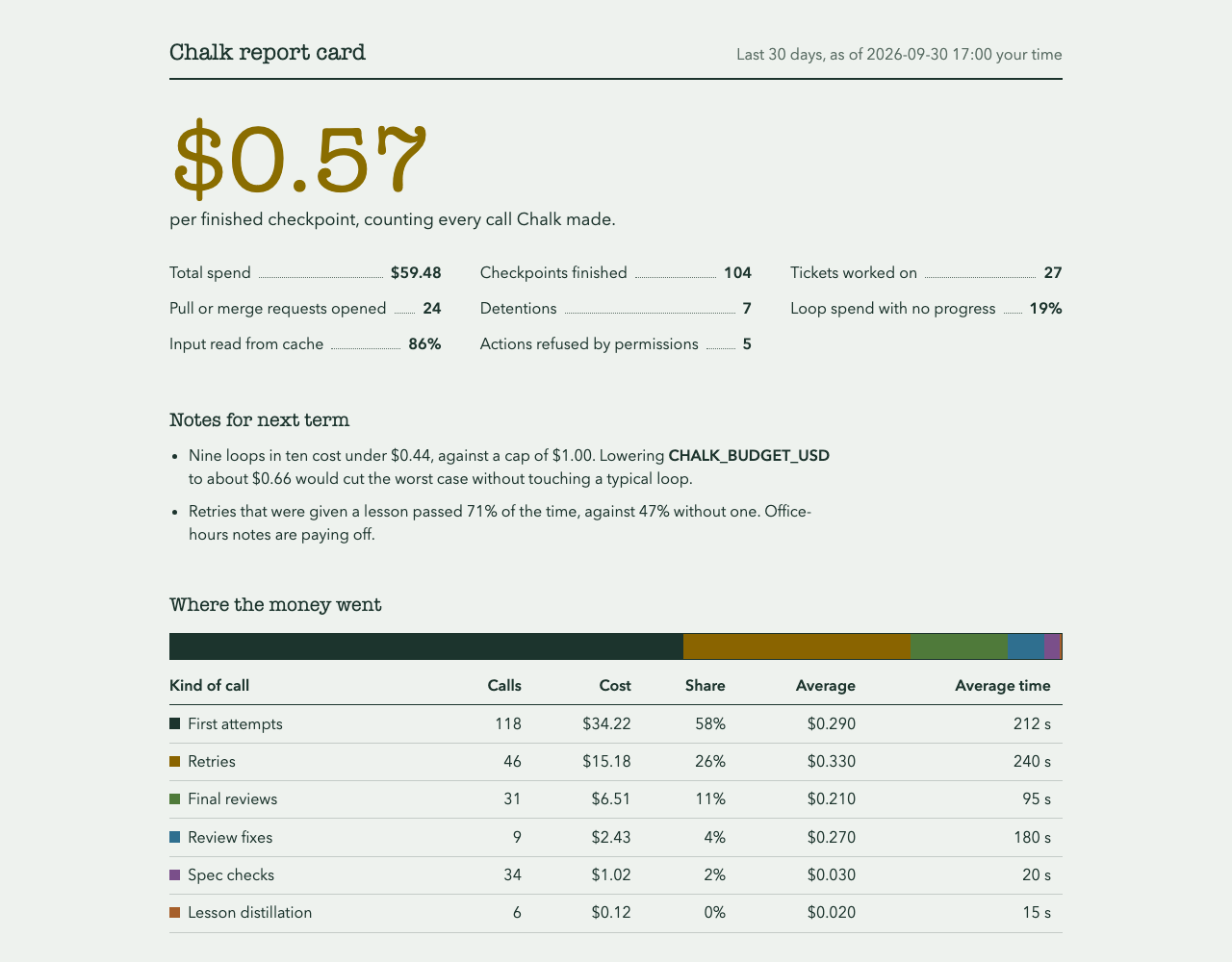
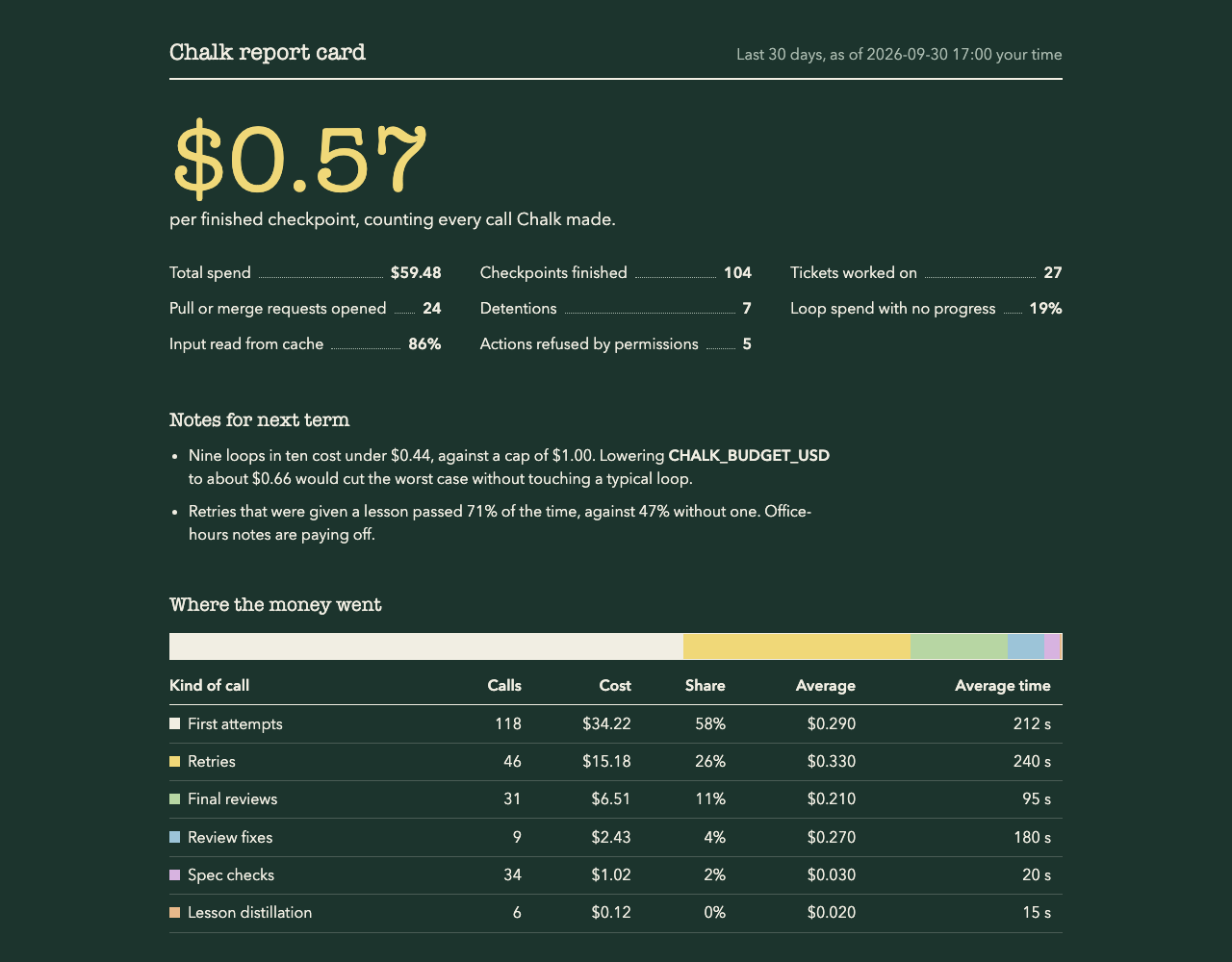
Sample data, not from a real run. See Verdicts and the report card.